
Kenosha Epoxy Flooring grinds and finishes polished concrete floors in Kenosha, WI, serving surrounding cities including Somers, Pleasant Prairie, Bristol, Sturtevant and Winthrop Harbor. After 20+ years of working concrete, we treat polishing as a craft of stages: each pass of the grinder refines the slab a little further until it is hard, dense and reflects light without a coating on top.
Polished concrete suits buildings where traffic is constant and maintenance budgets are tight, from distribution floors and retail showrooms to shops, offices and the lower levels of homes. Because the finished surface is the slab itself, there is nothing to peel, and the floor can be refreshed rather than stripped when it dulls.
Every polished floor starts with an honest look at the concrete. We read the cracks, joints, patches and old coatings before quoting, and our written proposal names the grit sequence, the densifier, any guard and the sheen we are aiming for, so you can check the result against the plan.
Commercial Polished Concrete Floors
Warehouse and Distribution Floors
Large distribution and light industrial floors are natural candidates for polish, because the slab is already there and a polished surface resists the dusting that bare concrete sheds under forklift traffic. We densify the slab, polish the traffic lanes and storage areas to a working sheen, and fill the saw-cut joints with a semirigid filler so wheels do not chip the joint edges as they cross.
A polished warehouse floor also reflects more of the overhead light, which can brighten aisles between tall racks. Because the work happens on the slab itself rather than in a coating that has to cure, sections can often return to service soon after the last pass, which helps when the building is shipping around the clock.
Retail, Showroom and Office Floors
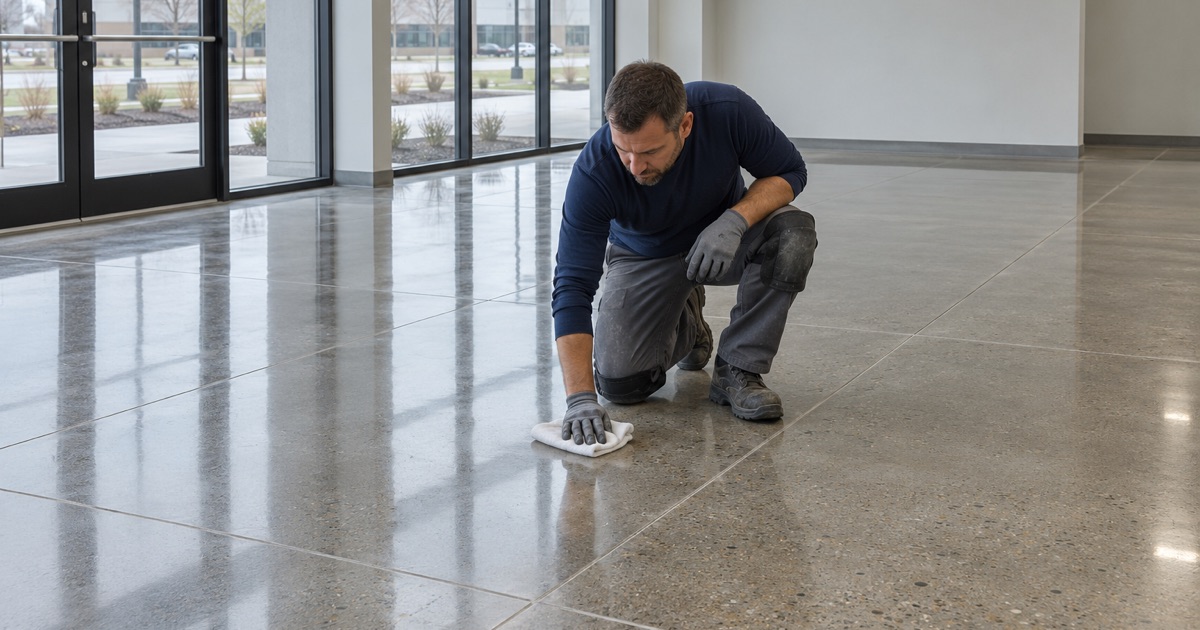
In a showroom or office, polished concrete gives a clean, modern floor with a level of shine that can range from a soft satin to a high gloss. We can expose more or less of the stone in the slab to change the character of the floor, and saw-cut lines or scored patterns can break up a large open space.
Retail floors take a beating from carts, displays and winter grit tracked in at the door. A densified, guarded floor resists that wear and cleans with an auto-scrubber, and the sheen can be matched across an addition or remodel so new and old areas read as one floor rather than two.
Schools, Clinics and Public Buildings
Buildings that stay open through the day need floors that are durable and easy to clean on a schedule. A polished floor needs no wax stripping, which saves downtime and chemicals over the years. We phase the grinding by area and plan overnight or weekend work so the building can keep running while the floor is done.
Residential Polished Concrete Floors
Basements and Lower Levels
A polished basement floor turns a plain slab into a finished surface that handles a little moisture better than many coverings. We test the slab first, because efflorescence and vapor still mark a polished surface, and we tell you plainly whether polish, a coating or a moisture-mitigation system is the right call for that floor.
Older basements often carry layers of paint, tile adhesive or patching compound that have to be ground away before polishing can begin. What lies underneath is not always pretty, so we show you a ground section first. Some owners love the character of an old slab, and others decide a coating suits the room better.
Garages and Workshops
Some homeowners prefer a polished garage to a coated one because there is nothing to lift under a hot tire. The tradeoff is chemical resistance: polished concrete can stain from oil, fluids and road salt residue if they sit, so we apply a guard and talk through how the space is used before recommending it over an epoxy or polyaspartic system.
Main Floors in Newer Homes
In homes built on a slab, polished concrete can serve as the finished floor in kitchens, living areas and entries. It pairs well with radiant heat and area rugs. Because every slab has its own color and marks, we grind a sample area so you can see what your concrete looks like before committing to the whole floor.
Our Step-by-Step Polished Concrete Floors Process
Step 1: Assess and Test the Slab
We check the slab for cracks, joints, patches, old coatings, adhesives and moisture, and we judge how hard the concrete is, since that affects which diamonds we start with. The assessment becomes a written scope with the expected finish and any repairs priced separately.
Step 2: Remove Coatings and Open the Surface
Old paint, epoxy, mastic and sealers are ground off with a diamond grinder or removed by shot blasting. Then the first metal-bond diamonds flatten the surface and set how much aggregate will show. This is the stage that decides whether you get a cream finish, a salt-and-pepper look or broad stone exposure.
Step 3: Repair and Densify
Cracks and pits are filled, and joints that need it get a semirigid filler. We then apply a lithium silicate densifier, which reacts with the concrete to harden the surface and reduce dusting. Densifying at the right stage makes the following polishing passes more effective.
Step 4: Polish Through the Grit Sequence
Resin-bond diamonds take the floor through progressively finer grits until it reaches the agreed sheen. Each pass removes the scratches of the one before it. Skipping grits saves time and shows up later as haze and swirl marks, so we follow the full sequence the scope calls for.
Between passes we check the floor under raking light and with a gloss reading where the scope calls for one. Edges, corners and the strip along walls get the same sequence with smaller machines, because a bright field with dull borders is the most common sign of a rushed polish job.
Step 5: Guard, Burnish and Hand Over
A penetrating guard can be applied to add stain resistance, then the floor is burnished to bring up the final shine. We leave you with simple care instructions and a record of the densifier, guard and final grit used.
Caring for a Polished Concrete Floor
Daily Cleaning and Grit Control
Sand and grit are what wear a polished floor, especially near doors in winter. Dust mopping and walk-off mats at the entrances do most of the work, along with occasional cleaning with a pH-neutral cleaner. Harsh acids and some deicing residues can etch the surface, so they should be cleaned up rather than left to sit.
Reburnishing Traffic Lanes
Over time, the busiest paths can lose some shine. Rather than stripping and recoating, a polished floor can be reburnished or lightly repolished in those areas. That maintenance is one of the main reasons owners of busy buildings choose polish in the first place.
Where Polish Is Not the Right Choice
Polished concrete is not the best answer everywhere. Commercial kitchens, food plants, wash bays and rooms that see harsh chemicals usually need a coating such as epoxy or urethane cement that seals the slab completely. When we see a floor like that, we say so before quoting rather than polishing a slab that will stain.
A slab that is badly cracked, heaved or soft at the surface is another case where polishing disappoints, because the grinder exposes every weakness rather than covering it. In those situations we explain the options, including repair, a topping or a coating system, and let you decide with the full picture.
- 20+ Years on Concrete
- Moisture Tested First
- Written System Proposals